 |  |  |  |
|---|---|---|---|
 |  |
Church of the Beheading of St. John the Baptist - Vaslui


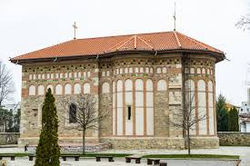
The Church of the Beheading of Saint John the Baptist in Vaslui, also known as the Royal Church of Vaslui, is an Orthodox church founded by Prince Stephen the Great (1457-1504) in 1490, in Vaslui. It served as a chapel for the Royal Court of Vaslui. Damaged by earthquakes, it was rebuilt from the ground up in 1820. The church is located in the city center, on Ștefan cel Mare Street no. 58.
The "St. John" Church in Vaslui is among the city churches built by the Moldavian voivode, along with the Precista Church in Bacău, the St. Nicholas Church in Iași, the St. John Church in Piatra Neamț, the St. George Church in Hârlău and the St. Nicholas-Popăuți Church in Botoșani. These city churches were part of the ensemble of princely courts existing in those localities. Over time, the Princely Court in Vaslui disintegrated, leaving only the church from the princely court complex.
For a long time, it was believed that this church was built after the Battle of Podu Înalt on January 10, 1475, when the Moldavian armies of Stephen the Great defeated the Turkish ones. This confusion originated from the chronicle of Grigore Ureche, in which the aforementioned chronicler wrote the following: "And in that praise and joy they built the church in the town of Vasluiu, giving praise to God for the victory he had made."
In 1882, Teodor Burada discovered the church's inscription and published for the first time the translation of the inscription. The church's inscription was preserved on the western wall of the building, in a frame, with an inscription in the Slavonic language that reports that this place of worship was built in less than five months (April 27 - September 20, 1490). The text of the inscription is as follows: "I, Stefan Voivode, by the grace of God, Lord of Moldavia, son of Bogdan Voivode, built this church with the name of the Beheading of the Holy and Glorious Prophet, Forerunner and Baptist John. It began in the year 6998, April 27, and was completed in the same year, September 20".
Historian Gheorghe Ghibănescu hypothesized in 1926 that this church was built on the site of another, older, wooden church. He based his theory on the discovery of a very old tomb, which is not parallel to the church wall and which he attributes to Iurg Coriatovici, whom some Polish chroniclers claim to have reigned in Moldavia. A skeleton, fragments of a princely robe, nails and rotten remains of a wooden coffin were discovered in the tomb. Ghibănescu states the following: "Indeed, in 1575 the Church of St. John in Vaslui was made of stone, built by Stephen the Great in 1490; but it is clear that, before that, there had been another wooden one, according to the tombs now found inside the church, one of which was very old, prior to the construction of the stone church, as is evident from the position of the tomb placed not parallel to the current wall, but to the old wall of the wooden church, which faced the winter sunrise". Subsequent archaeological research revealed two other foundations of small churches, in addition to the current church.
During the 17th-18th centuries, the church in Vaslui suffered greatly. During the great earthquake of 1802, the steeple on the nave cracked from top to bottom. The edifice collapsed completely in 1818, requiring the total reconstruction of the church.
The princely church of Vaslui was rebuilt in 1820 at the expense of Lady Maria Cantacuzino, widow of the great logophate Costache Ghica. The reconstruction works were carried out according to the original plan, with a porch and a bell tower being added. The previously existing spire, which Paul of Aleppo had mentioned, was not rebuilt. The wall separating the narthex from the nave was also dismantled. In the body of the porch, a series of profiled stones previously existing in the church wall were placed (probably in the dividing wall between the narthex and the nave).
At the top of the inscription is the coat of arms of the Cantacuzino family.
The church was repaired between 1889-1890 and frescoed in 1894 by George Ioanid, a student of the painter Gheorghe Tătărăscu. [8] In 1908, the Bishopric of Huși requested the authorities to approve the restoration of the bell tower. The Historical Monuments Commission conducted research in 1912 for the purpose of restoring the church, removing the exterior plaster from 1820 and revealing the existence of bricks, disks and enamel buttons. The restoration works were carried out between 1914 and 1928, and were coordinated between 1923 and 1925 by the architect Nicolae Ghica-Budești. [7] The porch added in 1820 was demolished, and fragments of carved stone from the main door from the time of Stephen the Great were found in its wall. With the help of these stones, the entrance door, located on the west wall, could be reconstructed.