 | |  |  |
|---|---|---|---|
 |
Ion Creanga's Bojdeuca


Ion Creangă's Bojdeuca in Iași is the first literary museum in Romania, inaugurated on April 15, 1918. The first museographer who presented Bojdeuca to those who came to visit it had the right to live in the small kitchen to the left of the entrance, together with his wife, three children and grandmother.
In his time, Ion Creangă was known for the fact that at his house in Țicău he owned a fairly large group of cats (approximately 30), and each one bore a name associated with a real person in his life. For example, he always had a cat named Marioara, like his stingy aunt from his native village of Humulești.
Ion Creangă bought the bojdeuca in the summer of 1879, through a Deed of perpetual sale, from Maria Ștefăniu (married Ciogole), for 50 Austrian gold, in the name of Tinca Vartic, he only signing as a witness to the transaction. After his death, Tinca Vartic, the woman about 15-16 years younger than him, remained in the house, who stayed at his bedside until the last moment.
This house, consisting of two rooms, hosted Ion Creangă (1837-1889) from the summer of 1872, when he was diagnosed with tuberculosis and had to leave his home in the Golia Monastery, until his death. The man from Humulești moved here, in the room on the right, having as a neighbor Ecaterina Vartic, the one who would take care of him for the rest of his life. and were written in the house named after the writer. In the summer and autumn of 1876, Mihai Eminescu also lived here, hosted by his good friend Ion Creangă.
After Tinca Vartic's death, which took place on September 3, 1912, the bojdeuca remained with Constantin Deliu, who proposed, in 1915, to the Iași City Hall to buy the house. The bojdeuca was purchased on November 20, 1917, by the "Ion Creangă" Committee, on the same day the building was donated to the University of Iași, according to the volume "Bojdeuca "Ion Creangă". From the history of the first literary museum in Romania”, signed by the museographer Iulian Pruteanu-Isăcescu.
The first literary museum in Romania cost 11,331.95 lei. As the “Gazeta Transilvaniei” wrote in July 1915, “the initiative was taken to restore the famous hut on the Scaricica hill, where the great storyteller once lived”, and “the credit goes to Mr. I. Mitru, the director of the “Vasile Lupu” Normal School, who, visiting Creangă’s hut with the teachers and students of the school, had the inspiration to collect a fund of one thousand lei, with which the hut could be restored. Once restored, the land on which the hut is built will also be consolidated, in such a way that the flowing waters will not collapse it again. At the same time, a commemorative plaque will be placed to show future generations that in this peasant palace lived the wonderful storyteller Ion Creangă”.
These funds were handed over to the “Ion Creangă” Committee, established on October 29, 1917, which had “the aim, first of all, of rebuilding Creangă’s bojdeuca, and then other measures, for the perpetuation of his name and work”.
After the restoration in 1918, the bojdeuca became a museum, under the administration of the University of Iași, transforming into a place of pilgrimage for those who wanted to see the house where the writer lived.
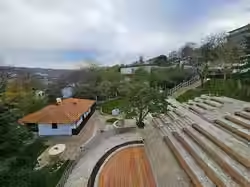
On May 19, 1933, the “Friends of Creangă” Association was founded with the aim of restoring the Bojdeuca again, after the restoration it became subordinated to the Iași City Hall. In August 1935, the decision was made to build a building in the Bojdeucii courtyard, necessary for the caretaker who lived in the museum
In April 1936, following the insistence of the liberal deputy Emil Ceicovschi, the initiative committee, formed by several personalities, including A.C. Cuza and Constantin Meissner (honorary presidents), Osvald Racoviță (mayor of Iași), Gh. Ghibănescu (historian), N.A. Bogdan (publicist), Emil Serghie (director of the National Theater in Iași), C.R. Ghiulea (president of the Journalists' Union), Ionel Teodoreanu (writer), C. Dumbravă (lawyer), Ion Botez (lawyer) and others. manages to restore the Bojdeuca and build a service home for its caretaker, thus preparing the museum for the Junimia Commemoration Celebrations of April 26-27, 1936 and the Centenary of Ion Creangă's birth, in March 1937.
In over a century of existence, Ion Creangă's Bojdeuca has undergone several restorations and renovations. The first action began in 1915 and ended in 1918, when it was inaugurated as a museum. In 1936, a new restoration took place and a building was built in the Bojdeuca courtyard, necessary for the caretaker who lived in the museum. Following the earthquake of November 10, 1940, Bojdeuca suffered greatly, and in 1942, free material from the Neamț Monastery was approved for its restoration.
In 1966, a re-profiling of Bojdeucia took place, aiming to evoke the way of life and the atmosphere in which the writer created by displaying original objects, as well as a series of reconstructions to complete the interior and complete the ambiance.