 |  |  |  |
|---|---|---|---|
 |  |
Mihai Eminescu Memorial House in Ipoteşti, Botoșani

Botosani, Mihai Eminescu commune, Ipoteşti locality,

Mihai Eminescu (born January 15, 1850, Botosani - died June 15, 1889, Bucharest) was a Romanian poet, prose writer and journalist, considered by literary critics to be the most important romantic writer in Romanian literature, also called the "star of Romanian poetry".
Through the depth of thought, the originality of expression and the harmony of language, Eminescu raised the Romanian literary language to a level never seen before. His influence is felt throughout the poetic and prose creation of the 20th century, inspiring generations of writers, from the symbolists to the modernists. The introduction of philosophical, mythological and cosmic themes, but also the valorization of folklore and national history, redefined the identity of Romanian literature. Leading critics, such as Titu Maiorescu and George Călinescu, recognized Eminescu's essential contribution to the formation of Romanian literary consciousness. Today, his work remains a fundamental landmark in the study of the Romanian language and literature.
Mihai Eminescu was born in Botosani on January 15. He was the seventh of eleven children of the housekeeper Gheorghe Eminovici, who came from a family of Romanian peasants from northern Moldova, and of Raluca Eminovici, the daughter of a steward from Joldesti. He spent his childhood in Botosani and Ipotesti, in his parental home and the surrounding area, in total freedom of movement and contact with people and nature, a state evoked with deep nostalgia in his later poetry (or
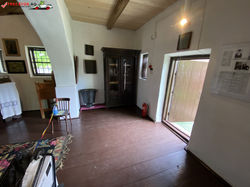
The Mihai Eminescu Memorial House in Ipotești is a memorial museum set up in the house where the poet Mihai Eminescu (1850-1889) lived in the village of Ipotești in Botoșani County.
In 1850, the family of the housekeeper Gheorghe Eminovici bought an estate in the village of Ipotești, where they built a house with all the amenities that can complete a wealthy household. The house had three rooms: the family living room, Eminescu's father's office and the bedroom of the poet's mother and sisters.
The poet's mother, Raluca Eminovici, bought a small family church with 250 gold coins, which dates back to the 1960s from a certain Murguleț. The place of worship is small, but it houses valuable objects. Behind the church are the graves of Eminescu's parents (Raluca and Gheorghe Eminovici) and two of his brothers (Iorgu and Nicu).
After the death of the housekeeper Gheorghe Eminovici (1884), the house was no longer inhabited, and it fell into ruin. A photograph from 1916 shows the precarious condition of the house: "the pillars of the porch were sliding forward" due to "a slow collapse and landslide". In 1924, the house where Mihai Eminescu grew up and which had remained uninhabited for years had become a ruin. At that time, the wooden church, like the graves of Eminescu's parents, were "completely abandoned and covered with rubble...", as he recorded in 1926, from Botoșani.
Because the Eminovici family house in Ipotești was in ruins, the owners of the Ipotești estate demolished it to the ground in the summer of 1924, prompting demonstrations by Romanian and Jewish students in Botoșani against this demolition. Following these protests, the owner of the Ipotești estate, Maria Papadopol, voluntarily donated the site where the Eminovici family house in Ipotești had stood.
In 1934, the house was rebuilt on the same site, and in 1940 the first memorial museum dedicated to the great poet was inaugurated there. This house did not respect the structure of the original, so it was demolished, and another one was rebuilt in 1979 according to original documents, on the old foundation of the Eminovici family house. The house contains furniture - some original, some from the second half of the 19th century.
In the courtyard of the Eminescu memorial house is is the Papadopol House, a period peasant house in the Moldavian style, which belonged to the last owner of the Ipotești estate - Dr. Papadopol. He donated his house to the state. Currently, the Ethnography Museum of the National Center for Studies in Ipotești is located here, exhibiting objects from old peasant households. Horia Bernea painted his paintings in this house, during the national painting camps in Ipotești.
4 kilometers from the Ipotești Memorial, there is the lake in the Baisa forest, a source of inspiration for many of Mihai Eminescu's poems.
The lake with water lilies in Ipotești, Mihai Eminescu commune, Botoşani county, is one of the most beautiful corners of nature in northern Moldova.
Located almost in the middle of old forests, the lake is full of blooming water lilies, and especially in the summer months it becomes a spectacle of nature, of a special enchantment.
The water lily lake at Ipoteşti is a top destination, being sought after by tourists from all over Moldova and the country.