 |  |  |  |
|---|---|---|---|
 |  |
Malinesti Monastery Vaslui

Gherghesti commune, Vaslui county

Mălineşti Monastery, one of the oldest monastic settlements in Vaslui County and the only one in the Huşi Diocese dedicated to the Protection of the Virgin Mary, is located in a picturesque place, in the forests that separate the communes of Gârceni and Băceşti, in the place popularly called "Hermitage Hill". Historical documents also record a village named Malineşti, which no longer exists today.
According to legend, before a battle with the Turks, Stephen the Great stopped in the Gârceni area with his army for three days and three nights, near the hermitage where the hermit Mălin lived. The voivode promised the hermit that, in case of victory, he would give the hermitage the marked estates as thanks to God. After winning the battle, Stephen the Great endowed the hermitage with land and forest, thus becoming a monastery.
As can be seen from the note made on a Pentecostal printed in Iași, the monastic settlement was founded in 1762 by the hieromonk Nicodim Hudici from Gârceni, and on the site of this church, the current wooden church of the monastery was rebuilt in 1826. The inscription placed above the entrance shows that the old church was built on April 30, 1826, by the craftsmen Teodor and Gheorghe, from oak wood. Next to the church, south of the lateral apse, the stone foot from the holy table of an even older church is still preserved today, which tradition says dates back to the time of Bogdan, the father of Voivode Stephen the Great.
After the reconstruction of the hermitage church on the site where it still stands today, the settlement, which had 18 inhabitants, had a prosperous life.
Following the secularization of monastic assets during the reign of Alexandru Ioan Cuza, the Mălinești hermitage became a church of myrrh and, over time, became a ruin. It remained in a state of desolation for almost 70 years, until the time of the pastorate of Bishop Iacov Antonovici, who, following a visit made here, recorded: "On October 27, 1928, I was with Father Econom Constantin Ulea, Protoiereul Vaslui County, Circumscription I, to see for the first time the former Mălineşti hermitage, where I had made up my mind to settle nuns from the Adam monastery. But for this a lot of work and money are needed. The locality is wonderful! Hope in God and the help of Mr. and Mrs. Prezan."
Indeed, the monastic settlement came back to life with the financial help and involvement of Marshal Constantin Prezan and his wife Olga, who had established their residence in a nearby village, Schinetea, where the Marshal would be buried, 15 years later.
After the renovation of the church and the cells, Mălinești became a nunnery and experienced a period of prosperity again, but not for long.
In 1956, the construction of a new church began, but it was never finished because, in 1959, as a result of Decree 410 of the communist regime, the Mălinești hermitage was dissolved and its assets were divided. The new church, which had been built up to the roof, was abandoned, and in 1964 it was dismantled, piece by piece.
Another 25 years of desolation followed in Mălinești, until 1990, when monastic life was reborn, with the arrival here of a group of monks. Four years later, the most holy Eftimie, then bishop of Roman and Huși, entrusted the work of restoring the monastic settlement to hieromonk Filip Mercaș, the current abbot of the Mălinești Monastery.
"In 1995, the venerable Bishop Ioachim Mareș consecrated the site for the construction of the monastery chapel and the new body of cells, dedicated to the Covering of the Virgin Mary and the Holy Pious Parascheva. In 2004, the painting of the chapel was completed, and in 2005, His Holiness Corneliu, Bishop of Huși, consecrated the refectory and the cells of the monastery. In the following years, with the blessing and support of His Holiness, the spiritual activity and the construction and beautification works of the holy place continued to take place in very good conditions," says protos. Filip Mercaș.
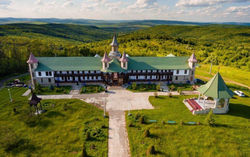
Currently, the community of the monastic settlement consists of five residents, and the liturgical program of each day includes the Seven Lauds and the Holy Liturgy. The monastic ensemble consists of the old wooden church "St. Voievozi", a historical monument, the new church, with the patron saints of the Covering of the Virgin Mary and the Holy Virgin Parascheva - a large and imposing construction, which includes the ensemble of cells and the refectory -, then a summer chapel, a wooden bell tower and a vast inner courtyard.
The Mălinesti Monastery is one of the most famous in the Huşi diocese and thanks to the icon of the Virgin Mary, which is said to be a miracle worker.