 |  |  |  |
|---|---|---|---|
 |  |
The Beautiful Monastery

Radu Voda Street, no. 1, Iasi

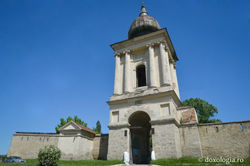
The Frumoasa Monastery in Iași is an Orthodox nunnery. It was founded in the 16th century by Hetman Melentie Balica and rebuilt several times over time. The current church of the monastery was built between 1836 and 1839 by Abbot Ioasaf Voinescu. The church is located at the foot of the Cetățuia hill, on a hill overlooking the floodplain of the stream.
Towards the end of the 16th century, around 1583-1586, Hetman Melentie Balica built a monastery in the Bahlui Plain, on a site donated by Prince Petru Șchiopul. The construction period of the monastery is dated to this interval, in the absence of a written record and other documents, based on the fact that Hetman Balica returned to Moldavia from exile in 1583 (after the return to the throne of Petru Șchiopul) and on the mention in a document that Hetman Balica was already dead in 1586.
Balica was a descendant of the great family of the Buzești boyars from Wallachia, being the son of the baker Gherghina Buzescu and Maria, daughter of Petru Rareș, and a relative of the Movileștii. He held the offices of cupbearer (July 16, 1576 - July 4, 1578) and Hetman (April 2, 1579 - August 21, 1581). The church founded by Hetman Balica and his wife, Ana, was dedicated to "Saints Archangels Michael and Gabriel" and was dedicated to the "Transfiguration" Monastery on Mount Sinai. On February 12, 1618, Prince Radu Mihnea elevated the church to the rank of monastery [10], preserving its devotion to Mount Sinai. In 1653, Archdeacon Paul of Aleppo mentioned the existence of several houses within the monastery.
In the 17th century, Balica Monastery benefited from several donations, mainly from the rulers of Movilești. However, wars and the mismanagement of its assets by the Greek monks led the monastery to a state of ruin.
Built in the Bahlui Plain, on the place called "Galata" at the end of the 16th century, the Frumoasa Monastery, with its palaces and gardens, represented a place of rest and entertainment for the rulers. The first documentary attestation of the monastery dates back to April 10, 1587, during the reign of Prince Petru Șchiopul.
The era of splendor of Frumoasa is during the reign of Grigore Ghica II. After the demolition of the palace at Frumoasa, the monastery was built by Grigore Ghica, during his first reign, starting in 1729, with paid craftsmen. For the princely palaces, the craftsmen were brought from Șarigrad. Behind the monastery, by diverting the waters of the Nicolina stream, an artificial lake was made, equipped with "boats for walking". Next to the lake was a very large terraced garden. The church was rebuilt by the ruler in the Renaissance style, the new construction impressing his contemporaries who nicknamed it "Frumoasa". This name of the church appears for the first time in a Greek note from 1723 on a Gospel of this one, found in Bucharest and redeemed by the protosinghel Silvestru.
Frumoasa served as a place of relaxation for other lords, according to Grigore Ghica.
Also, in the 18th century it was used to host important guests: Suleiman Pasha, the British ambassador James Porter, the sultan's son-in-law, Hamza Pasha.
In the 19th century it served as an auxiliary residence for the lords of Moldavia or as a stopping place for the princely processions coming to Iași. Here, coming from Constantinople, the princes who were enthroned stopped. This ceremony was established after the return to the earthly kingdoms (1822). Prince Mihail Sturdza decorated the interior of the church and erected next to it, in 1833, a white marble mausoleum to house the tombs of his family members. The monument recalls the beginnings of statuary sculpture in Moldova.
In the courtyard is the house called "the palace on the walls" or "Sturdza Palace", built between 1818-1819 with a ground floor and an upper floor, last restored in 1982-1983. The "Palace on the Walls" has a tripartite structure, and as a special feature of the construction we mention the fact that the traditional gazebo has become an access platform here, and on the first floor, a covered terrace. In the courtyard there are also the ruins of the old boyar houses from the time of Grigore Ghica and the tomb of the Sturdza family (father of Prince Mihail Sturdza) and other family members, two of whom are related to the Vogoride and Mavrogheni families.
Within the Frumoasa Monastery there are also the ruins of the princely palace as well as a building called "Palace on the Walls". In the "Palace on the Walls" the chapel "St. Catherine" was arranged in 1841. On the east side of the enclosure walls, a wooden gate known as the Hanged Gate can still be opened today. According to tradition, those who were sentenced to death and were about to be executed passed through here.
After 1863, Frumoasa served as a barracks. Before World War I, it was a military hospital for ophthalmological diseases.