 |  |  |  |
|---|---|---|---|
 |  |
Metropolitan Cathedral of Iași

16 Stephen the Great and Saint Boulevard, Iași

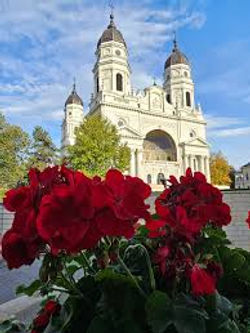
The Metropolitan Cathedral of Iași (16 Stefan cel Mare Blvd.) is the cathedral church of the Metropolitanate of Moldova and Bukovina, dedicated to Saint Parascheva, the Presentation of the Lord, and the Holy Martyr George. The church is 56.7 m long, 34.15 m wide at the apses, and 24 m high at the nave. With its height of 52.92 m, the cathedral ranks first among the tallest historical buildings in Iași, and probably in Moldova as well.
The metropolitan cathedral was affected by earthquakes and fires, according to documents of the time. In a charter dated August 8, 1826, Prince Ioniță Sandu Sturdza (1822-1828) appealed to the entire population of Moldavia to contribute to the construction of a new metropolitan cathedral, due to the fact that "the two in which this holy metropolis is today bordered are, in addition to being old, small and damaged, shaken by earthquakes and dangers, and the rebuilding of a holy place of the metropolis with its bell tower together is necessarily required".
The princely charter dated August 8, 1826, issued by Ioniță Sandu Sturdza, Prince of Moldavia between 1822-1828, regarding the design and construction works of the new church, is considered to be the birth certificate of the Metropolitan Cathedral. The church was built on the site of two older churches: the White Church (from the 15th century) and the Stratenia Church (from the 17th century).
In 1880, Metropolitan Iosif Naniescu laid the second foundation stone and, with the support of the state authorities, the works were completed in 1887. The architect Alexandru Orăscu, then rector of the University of Bucharest, redesigned the grand church, abandoning the immense central dome. He added the two rows of massive pilasters inside, creating a basilica-style building, with a central nave and two smaller side naves. Alexandru Orăscu kept the four detached side towers, but abandoned the large central dome, replacing it with a system of four vaults, separated by transverse arches.
The interior painting was done by the master Gheorghe Tattarescu.
The consecration of the Cathedral on April 23, 1887, was a national event, with King Carol I and Queen Elisabeth attending the ceremony.
In 1889, the reliquary containing the relics of Saint Parascheva, the patron saint of Moldova, was brought from the Church of the Three Hierarchs.
The Iași Cathedral is a monumental building, rectangular in plan, marked at the corners by four detached spires. The architectural style is inspired by late forms of the Italian Renaissance. The decorative elements, both inside and outside, are dominated by Baroque. Architect Alexandru Orăscu (1817-1894), rector of the University of Bucharest, noting that the space between the side walls of the church was too large, constantly undermining the vault (which had already collapsed in 1857), decided to narrow this space by erecting massive pilasters with Corinthian capitals.
The Viennese architects Gustav Freiwald and Bucher adopted the neoclassical style for the new church, also found in other monumental churches in European countries with a great tradition in the field.
-The entablature develops much in height, in a balanced combination between the openwork and flat spaces. The generous dimensions of the basic register led to the appearance of an impressive liturgical veil, about 3 meters high.
The painted icons are separated from each other by detachable columns (ronde-bosse sculpture), with a fluted structure and a composite capital, imitating the Byzantine one (with volutes and acanthus leaves).
With a history of almost two centuries, the Metropolitan Cathedral of Iași becomes the place where tens of thousands of believers go on pilgrimage every year to worship the relics of the Holy Parascheva, the patron saint of Moldova. The feast of the Holy Parascheva is celebrated on October 14, and the religious holiday transforms the city of Iași into a powerful center of faith and hope, where pilgrims go to worship and pray to the relics of the holy protector of the poor and sick.