 |  |  |  |
|---|---|---|---|
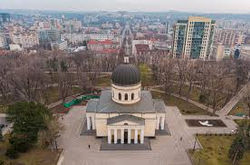 |  |
Metropolitan Cathedral of the Nativity of the Lord – Chisinau Municipality


The Metropolitan Cathedral of the Nativity of the Lord in Chisinau is an architectural monument of national significance, included in the Register of Historical and Cultural Monuments of Chisinau. It is located in the historical center of the city and is known for its impressive design and religious significance. The cathedral is a place of pilgrimage and a symbol of the Orthodox faith in the Republic of Moldova.
The first radio station in Chișinău, Radio Basarabia, was officially inaugurated by broadcasting the liturgy from the Metropolitan Cathedral on October 8, 1939.[
The initiative for the construction of the Cathedral belongs to Metropolitan Gavriil Bănulescu-Bodoni (1812–1821), its location being indicated in the first urban plan of Chișinău from 1817. The construction was carried out during the time of his successor, between 1832–1836 by Archbishop Dumitru Sulima (1821–1844). It is built of stone and brick, with three altars: central – Nativity of the Lord, lateral (originally dedicated): the southern one – St. Alexander Nevski, the northern one – St. Nicolai Mirlikysky. Today the two side altars are dedicated to the voivode Stephen the Great and the Intercession of the Virgin Mary, a holiday on which the city of Chisinau celebrates its patron saint – October 14. The architect of the holy place is Avraam Melnikov, a master of the Russian Empire style.
The cathedral ensemble consists of: the church or the cathedral itself, a four-tiered bell tower and the Holy Gates. The urban planning works highlight the concern for the creation of the urban center, and a special role in its architectural-spatial composition was to be played by the city cathedral. In the 1817 plan, the location of the cathedral, with a cruciform plan, was already indicated in the city center.
The architecture is in the late neoclassical style, also called Empire, with the use of ancient Greek forms for columns. It was built in eclectic style, a combination of the Byzantine Greek cross plan with the Renaissance principles of the central type. It has a symmetrical composition, in plan representing a square with a side of 27 m, by attaching to the cubic body four porticos of six Doric columns, a cruciform plan being obtained, with identical facades.
The dome, surmounted by a cylindrical drum, is supported by four square-section pillars, which take the weight through four double arches and four pendants. The covering of the parabolic dome, with radiating ribs, was made of sheet iron. Through the wide drum, 13 m wide, with 12 windows, the interior is flooded with light. The interior surfaces of the walls and vaults were painted with biblical and evangelical subjects. The plastered parts suggested the impression of marble slabs.
The cathedral suffered during the Second World War, the spire and the dome, the interiors being rebuilt with deviations from the initial forms.
The bell tower. It was built simultaneously with the cathedral, located 40 m away from it, symmetrical to the cathedral and to the geometric center of the cathedral district. It has four levels, three prismatic, with successively receding sides, and the fourth in the form of a circular pavilion in plan, for the bell chamber, covered with a dome. On the first level there was a chapel, the entrance to which was through a two-column portico, located on the southern side. Identical porticos adorned each facade of the bell tower, creating a repetition, on a reduced scale, of the cathedral composition, harmonizing with it and the shape of the domes. It was demolished in the 1960s of the 20th century and rebuilt in 1998 according to the images of the era.
The Holy Gates. For the largest bell, the windows of the bell chamber turned out to be too small. To accommodate the large bell, it was decided to build a special bell tower, the author of which was the architect Luca Zaushkevici, in which the function of the bell tower was combined with that of the entrance gate. The bell tower-gate acquired the shape of the Triumphal Arch, located at the entrance to the cathedral square from the direction of the Metropolitanate (destroyed during the war years).
In 1945, plaques were installed on the walls with the names of the fighters of the Soviet army and citizens, who fought on the territory of Bessarabia in World War II and received the distinction of "Hero of the Soviet Union". The plaques were removed in 1991, after gaining independence.
Since its construction, the Arc de Triomphe has had several names – it was also called the Holy Gates, and under the Soviet regime it was called the Arca de Victoriei and the Arca de Biruinței.
It is a construction in the spirit of the Empire style, the peculiarity of the arch in Chișinău lies in the solution of the passage in four directions, obtaining four identical facades, with four pillars. In plan it is square, with the pillars at the corners adorned on two exterior facades with a pair of Corinthian columns. The upper part is an attic, which rests on these four pillars, which corresponds to the bell chamber.