 |  |  |  |
|---|---|---|---|
 |  |
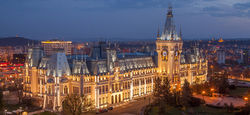
Palace of Culture in Iași

Stephen the Great and Saint Square No. 1, Iași, Romania, 700028

An architectural jewel of Iași, the Palace of Justice and Administration, built between 1906-1925 according to the plans of architect I.D. Berindey, stood out for its remarkable dimensions, but also for its specific decorative elements.
The central tower of the building, which reaches 55 meters in height, made the Palace considered the tallest building in the city at the time, with a footprint of 7,330 square meters and a surface area of 34,236.35 m.
Today, the Palace of Culture is the headquarters of the National Museum Complex "Moldova", which includes the Museum of History of Moldova (1916), the Ethnographic Museum of Moldova (1943), the Art Museum (1860), the "Ștefan Procopiu" Museum of Science and Technology (1955), as well as the Center for Conservation-Restoration of Cultural Heritage (1975). Until the renovation works began, the northeastern wing of the palace housed the headquarters of the "Gheorghe Asachi" County Library (1920).
In addition to its monumentality and beauty, the building was distinguished by modern technical installations and equipment, purchased from Germany, as well as by the hardware made by the Haug House and the renowned French firms Krieger, Mericier and Bagvès. The furniture of the Palace of Justice, in neo-Gothic style, was designed and made in the famous Albert Goumain workshops in Paris and by the Mappel company in England.
The building opens through a generous hall – the Hall of Honor, designed in neo-Gothic style, a space that ends with an ogive vault decorated with stained glass. The decorations of the space were designed in two different stages: the early era, until 1914, called the era of Carol I (1866-1914), and the era of Ferdinand I (1914-1927), differentiated by the style in which they were made.
The era of Carol is predominantly neoclassical, the era of Ferdinand is predominantly baroque, combined with Art Nouveau. The involvement of Queen Maria, a great lover of Art Nouveau, in the second stage is known, and her monogram can also be found in the Hall of Voivodes.
In the first period of construction, the style used was sober and severe, in the second stage the ornaments multiplied, and the decorative elements were strongly marked by the Baroque: composite capitals, brackets in brackets decorated with floral and vegetal elements or simple and elegant neoclassical brackets, decorative friezes with vegetal, floral or zoomorphic elements and many heraldic shields, many with historical heraldic significance, many only decorative.
Hall of the Voivodes
The symmetrical monumental stairs are built of Carrara marble, and the parapet is made of brackets balusters, decorated with eagles with shields, which symbolize the opening of roads. The marble is white, with a discreet veining, the landings are made of mosaic in a chessboard pattern with tiles, identical in size to those on the first floor, but different in color (white and dusty pink). The white tiles are made of marble, the colored ones of stucco-marble.
"Henri Coandă" Hall
The entrance to the "Henri Coandă" Hall is guarded by two pedestals that today lack the original busts. They still bear the names of the former ministers of justice Matei B. Cantacuzino (1855-1926) and Gheorghe Mârzescu (1834-1901). The two busts were highlighted by sumptuous backgrounds made of "Byzantine mosaic".
The Clock
Beyond the architecture, the clock in the tower of the Palace of Culture contributed greatly to the building's fame. It inherited the memory of the clock installed in the tower of the Royal Court gate in 1728 and which set the rhythms of the city for a long time. Installing a clock with a carillon is in itself a romantic option.
The National Museum Complex "Moldova" Iași
The First World War and the difficult years that followed postponed the completion of the finishing touches for several years, causing the official inauguration to take place only on October 11, 1925, in the presence of the royal family, King Ferdinand and Queen Maria.
Over time, the ensemble of the princely court (documented since 1434) developed in that area of the city. In 1804 - 1806, Prince Alexandru Moruzi built an imposing princely palace in the neoclassical style (architect Johan Freywald). Affected by fires, the palace would be rebuilt by Prince Mihail Sturdza, in 1841 - 1843 (architect Nicolae Singurov). After the Union of 1859 and the relocation of the capital to Bucharest (1862), the building became an administrative palace. A fire in 1880 again affected the building, which was rebuilt between 1880 and 1883. At the beginning of the 20th century, the decision was made to rebuild the entire palace in a new style according to a plan that also provided for the enlargement of the surface by adding new buildings, in order to increase the functionality of the building. The first works involving the dismantling of the old palace took place in 1906.[1][2]
The reconstruction and extension works began in 1907, preserving the main foundations, the ground floor and part of the walls of the first floor from the old palace. The new building was built in the neo-Gothic style, according to the plans of