

Bechir's Ravine, also known as "Bechirov Iar", is a spectacular natural formation located in Soroca district, Republic of Moldova. This area, with an area of approximately 46 hectares, is notable for its impressive landscapes and its geological and cultural importance. Bechir's Ravine is a geological and paleontological monument of great value. Its sedimentary formations, which include Cretaceous, Badenian and Volhynian deposits, offer researchers the opportunity to study the geological strata of the East European Platform. In the upper parts of the ravine, loess and reddish-brown clays are found, which hide archaeological remains of the Cucuteni-Tripolia culture, adding additional scientific value to this natural monument.
The cave hermitage "Bechir's Cave" is a cave hermitage located on the steep cliff to the left (north) of the Bechir Ravine (Bechirov Iar), south of the city of Soroca, Soroca forest district, Zastânca II, plot 24. It is a historical monument of national importance included in the Register of State-Protected Monuments of the Republic of Moldova with no. 2820.1 (Soroca district). It dates from the 18th-19th centuries.
In the steep cliffs of the valley is the Bechir cave hermitage, considered the oldest one that has survived to this day, probably dating from the 6th-8th centuries. The first written evidence that there was a hermitage here is from the 19th century. It is also called Bechir's Cave, sometimes associated with the name of an outlaw, sometimes with that of a monk. The cave-church is carved into the rock and is reminiscent of cave settlements from various corners of the Christian world (Caucasus, Crimea, Central Asia), being in this sense unique for the Romanian space. It is located in a gorge whose length is 10 kilometers, through which a small river flows towards the Dniester, with massive and steep limestone slopes, partially wooded, not far from the stone bridge of the same name in the southern part of the city of Soroca. According to the legend, which circulates in the area, in this cave a few centuries ago, a hermit monk lived. On Sundays he would appear in front of the crowd gathered in the valley of the gorge and read sermons to them.
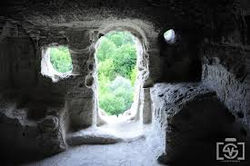
Inside the cell, a table, a niche for an icon and a candle, and even a cellar are carved into the rock. The slopes of the gorge were formed by Cretaceous, Tortonian and Sarmatian deposits, as well as terraces, which date back to the Ice Age. The length of the gorge exceeds 10 km, the width of the mouth is 375 m, and the depth in some places is about 100 m. The Cretaceous rocks, whose height reaches 50 m, look particularly imposing.
The hermitage consists of a small room oriented with the altar to the north and with a small window-door to the south, but has an interior decorated with stone-carved construction elements that imitate the interior of a period wooden church. Traces of icons can be seen on the walls. The cave is located at a height of 12-14 m on a vertical white limestone cliff. This remains difficult to visit for most tourists even now. The hermitage is under state protection and unauthorized entry is not allowed. The monument has great scientific importance, as it preserves ancient geological outcrops.
On March 27, 2004, the Cultural Tourist Complex "Lumânarea Rekunoştinei" was inaugurated in Soroca. Initially, the monument was to be called "Badea Mior", the idea being proposed by the writer Ion Druță, originally from Câmpia Sorocii. This tourist attraction with a height of almost 30 meters was built based on the project of the architect Ion Pascal. The most attractive thing is the place itself, from where a beautiful panorama opens over the city of Soroca and the surrounding landscape.Although many people come here by car on the road from the village of Zastânca, there are also brave people who choose to climb the 564 steps to the “Candle of Gratitude”.
Bechir’s Ravine can be reached from the Candle of Gratitude area, located south of the city of Soroca, Republic of Moldova. The route starts from the parking lot by the road and follows a path that leads to Bechir’s Ravine, where Bechir’s Cellar, a cave carved into the rock, is located. This path is short, but steep and slippery, requiring caution and appropriate hiking equipment.
The cave hermitage “Bechir Cave” can be admired when walking on the serpentine at the entrance to the municipality of Soroca. Although it is in sight, access to the cell is very difficult, due to the height of over 6 meters from the ground level. The name “Bechir Cave” was given by the locals, Bechir being the name of the last outlaw from Bessarabia who would have taken shelter in the rock several centuries ago.
Bechir's Ravine is not only a geological and historical site, but also a special tourist destination, offering spectacular views of the Dniester Valley and opportunities for hiking in nature.