


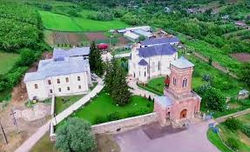


Florești village, Poienesti commune, Vaslui

It is an Orthodox monastery, located in the village of Florești, Vaslui.
The monastery is located on the western edge of the village of Florești, at the end of a road that winds through the famous Tutova Hills, 38 km northwest of the municipality of Bârlad and 32 km southwest of the municipality of Vaslui.
The Florești Monastery (community of nuns) is dedicated to "Saint Prophet Elijah the Tesviteanul" - the church; "Assumption of the Virgin Mary" - the chapel
According to legend, monastic life in this land blessed by God goes back in history to the time of Stephen the Great, more precisely around 1480, when a nunnery named Floarea or Florentina was needed here, who built a hermitage, at the place called "Coada iazului de piatră".
The first written information attesting to the existence of a monastery in this region is the document of April 19, 1596, by which the great vornic Cârstea Ghenovici offered as a tribute to the holy place the village of Florești, bought from the descendants of Lazar the baker. In the same year, on June 27, the founder, together with his wife Anghelina, donated a Tetraevangelium, a manuscript that is preserved to this day at the National Museum of History of Romania, on the door of which is mentioned the patron saint of the monastery, under the protection of the Holy Great Prophet Elijah the Tesvitean.
By the charter of April 25, 1616, Ștefan Tomșa strengthens the Smila Monastery, with the patron saints "Saint Elijah and Saint Nicholas", the village of Ferești, with a mill on Racova, which had him as a mercy from Ieremia Movilă, thus being mentioned for the first time the second patron saint, "Saint Hierarch Nicholas". According to historians, he would also be the protector of the wooden church erected by the nun Floarea over a hundred years ago and which coexisted for a period with the wall church. In the following centuries, the descendants of Cârstea Ghenovici will take care of the existence of the holy place, especially the Costăchești family, endowing it with countless estates and repairing, whenever necessary, the ecclesiastical buildings within the monastic ensemble. Thus, around 1686, the boyar Gavril Costache will begin a new stone church, entrusting its construction to a team of craftsmen led by Nicolae and Ștefan. The church will be completed a few years later, after the death of the founder, by Pătrașcu Bujoreanu, his relative, who will later become a monk here, with the name Silion.
In the 18th century, the monastic complex will undergo new restorations, as a result of calamities. On May 31, 1738, an earthquake occurs, affecting the church and the bell tower, and five decades later, in the spring of 1788, a terrible earthquake destroys the cells entirely, and the church remains without a roof.
Seeing the deplorable state in which the holy place had reached and in an attempt to restore monastic life here, at the beginning of the 19th century, the successor of the old founders (Metropolitan Veniamin Costachi) will dedicate the holy place to the Esfigmenu Monastery on Mount Athos, as was the custom of the time. Thus, on August 20, 1806, in the presence of 12 members of the Costăchești family and the abbot Theodorit of Esfigmenu, the acts of dedication will be signed, each party having the obligation to take care of the smooth running of the monastery. The support of the etherist movement by the abbot Luca results in the removal of the Florești Monastery from the administration of the Holy Mountain. According to Professor Costin Clit, the place of the Greek monks was taken by nuns brought from the Văratec Monastery in 1826, who would live here under the leadership of the shemacon Xenia Cuza, until 1834, when the Greeks returned. The nunneries would be moved to the Adam Monastery.
As a result of this approach, the Florești Monastery would experience a period of development in the 19th century, especially from an administrative point of view. Only Greek abbots would be appointed to the leadership, among whom we mention the abbot Luca (during which the Florești Monastery was declared a stavropighia of the Ecumenical Patriarchate), Archimandrite Gherman (1834-1839) and the most famous of them, Archimandrite Nil (1843-1862), who would give a new look to the monastic complex. During this period, the wealth of the monastery will increase, and new church buildings will appear within the monastic complex.
Starting with 1863, the influence of the Greek abbots in the management of the monastery will end, as a result of the law of secularization of monastery assets. Thus, on November 19, 1863, the administration of the holy place will be delegated to the priest Ioan Bulboacă.
After the departure of the Greek monks, the monastery will become a parish church in which religious services will be held for the inhabitants of Florești and the surrounding villages. Subsequently, after a period of stagnation, the works on the ecclesiastical buildings started by the abbot Nil will be resumed. Thus, in 1874, the leadership of Vaslui County makes arrangements with the relevant ministry and, after long interventions, obtains approval for the completion of the church.