




Chisinau Municipality, Republic of Moldova

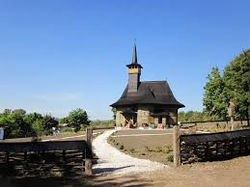
The wooden church of the Dormition of the Virgin Mary in Hirișeni is a religious building built in 1642, today located in the Village Museum in Chișinău, Republic of Moldova
It was founded by the Răzeși Hirișeni in 1642 at the Hîrjauca monastery. In 1821, it was transferred to the commune of Hirișeni in the Telenești district, where it served the locals until 1928, when a stone church was built in the locality. The wooden church continued to be used as a cemetery chapel.
The wooden church of the Dormition of the Virgin Mary in Chișinău is the oldest in the Republic of Moldova that still preserves medieval architecture today.
“In 1820, the church had already begun to wake up and the monks asked for a blessing to dismantle it and build another one of stone, which happened. This church was given to the Christians from the village of Hirişeni, who took it, replaced what was rotten with new oak from the forests of Moldova and served in this church for another 100 years”, according to the reports of priest Sergiu Curnic.
“When I found it in 2009, the church was all collapsed, it was a pile of wood, along with the icons, with the church books. Basically, I repeated the practice and technique of our ancestors, I took it from the territory of the Village Museum. I restored it, I replaced the old beams with new ones, I restored all the icons and I put the church in value”, mentions Sergiu Curnic.
Thus, for the third time, three centuries after its foundation, the church was rebuilt. 400 old beams were used in the restoration, each of which was numbered and arranged in its place, exactly as it was in the past.
"When I found the church, it was in the ground. These beams are original, from the very period when it was founded. The rotten ones were replaced with new oak. There was a legend: the church was built by monks from the Harjauca Monastery, that was the name of the technique - dovetail", says the priest.
The restorers also wanted to preserve the secular icons.
"This icon is a testament to how we found the icons in this church. They were frozen, moldy from moisture. By restoring each icon, we have reached such a quality that the painting no longer crumbles, it is very resistant", says priest Sergiu Curnic.
When you step on the threshold of this church, when you look at the icons that have listened to thousands of prayers, you are overcome by a state of reconciliation and peace, proof that we carry in our souls the values of our ancestors who prayed for almost 400 years in this small wooden church, a jewel of our nation.
By the beginning of the 21st century, the church was in a deplorable state. Lacking a roof, the wood was visibly affected by rain and snowfall. The National Museum of Ethnography and Natural History held long negotiations with the locals in order to be able to move the church to Chisinau. This happened in mid-2009, after which the restoration works began immediately. The restoration project, led by architects Eugen Bâzgu and Sergiu Vornicov, was carried out by a team that already had experience in restoring the wooden church in Palanca, Călărași district.] The restorers wanted to preserve as many original elements of the church as possible, so the old beams were processed with special materials to give them durability, and the original structure was preserved in a proportion of 75 percent. Only the roof was completely changed.
The consecration of the church in the new place took place in the fall of 2011, on the feast of the Assumption of the Virgin Mary. It is the oldest ecclesiastical monument in the Republic of Moldova, as well as the largest wooden church in the country, with a height of 27 meters. At the moment, the church is, according to the scientific secretary of the National Museum of Ethnography and Natural History Varvara Buzilă, the only one of its kind in the Republic of Moldova. "Its style is Moldavian, of the Nordic type, and it is close to the tradition of churches in northern Moldova, Bukovina, if you will. Today, we do not have another church of this type, so tall and well-proportioned," said Varvara Buzilă. There was a similar church in Telenești district, but it was demolished in the 1980s.
The medieval wooden church "Assumption of the Mother of God" operates normally and has its doors open to all Christians, and besides being a spiritual place, the church is also a special historical and architectural monument